Apr 29, 2007

My Beloved Grandfather - A few words by MHI

My Beloved Grandfather
A few words by Mowlana Hazar Imam

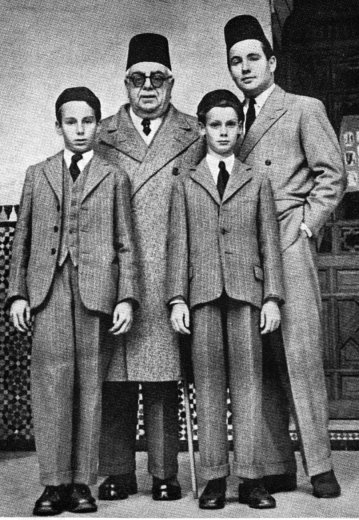
Aga Khan III with son Prince Aly Khan and Grandsons Mowlana Shah Karim al Hussayni Hazar Imam, the Aga Khan IV and Prince Amyn "Today, I am speaking to you in a city and in a country which have a particular meaning to my family and myself. On 2nd November, 1877 my beloved grandfather was born here in Karachi. Through 72 years of Imamat, he guided his spiritual children to happiness and prosperity..."
- Karachi, August 4, 1957

"Many many memories come to our minds as we think of him. He achieved in his life, for our community, that which could only have been accomplished normally in a period of many generations. The tributes that the world has paid him bear honest testimony to his great life and work."
- Takht Nashini, Karachi, January 23, 1958

"You have said, Mr. President, some very kind words about my late grandfather, my late father and myself. My grandfather was a most gifted person, and amongst his many qualities, one of them had always particularly impressed me. While the past was a book he had read and re-read may times, the future was just one more literary work of art into which he used to pour himself with deep thought and concentration. Innumerable people since his death have told me how he used to read in the future, and this certainly was one of his very great strengths. As a child I used to listen to him for many hours on end and I think, in fact I am convinced, that it was his inspiration which has created in me such a strong interest in the future, while at the same time, guiding me to learn from the teaching books of the past."
- Karachi, December 12, 1964


Apr 25, 2007

The Imamat and the AKDN

The Imamat and the The Aga Khan Development Network (AKDN)

The Aga Khan Development Network (AKDN) is a contemporary endeavour of the Ismaili Imamat to realise the social conscience of Islam through institutional action. Themandate of the eight AKDN agencies is to improve living conditions and opportunities, and to help relieve society of the burdens of ignorance, disease, and deprivation.


Imamat and the AKDN

The Aga Khan Development Network (AKDN) is a contemporary endeavour of the Ismaili Imamat to realise the social conscience of Islam through institutional action. The Network brings together a number of agencies, institutions, and programmes that have been built up over the past forty years by the Aga Khan, and in some instances by his predecessor, Sir Sultan Mahomed Shah, Aga Khan III.

Their combined mandate is to improve living conditions and opportunities, and to help relieve society of the burdens of ignorance, disease, and deprivation. AKDN agencies conduct their programmes without regard to the faith, origin or gender of the people they serve. Their primary focus of activity includes some of the poorest peoples of Asia and Africa. The impulses that underpin the Network are the Muslim ethic of compassion for the vulnerable in society and the duty, guided by the ethics of the Islam, to contribute to improving the quality of all human life. The pivotal notion in the ethical ideal of Islam is human dignity, and thus, the duty to respect and support God's greatest creation, Man himself.

At the heart of Islam's social vision is the ethic of care of the weak and restraint in their sway by the rich and powerful. The pious are the socially conscious who recognise in their wealth, whether personal talent or material resources, an element of trust for the indigent and deprived. But while those at the margin of existence have a moral right to society's compassion, the Muslim ethic discourages a culture of dependency since it undermines a person's dignity, the preservation of which is emphatically urged in the Quran. From the time of the Prophet, therefore, the emphasis in the charitable impulse has been to help the needy to help themselves.

The key to the dignified life that Islam espouses is an enlightened mind symbolised in the Quran's metaphor of creation, including one's self, as an object of rational quest. "My Lord! Increase me in knowledge," is a cherished prayer that the Quran urges upon all believers, men and women alike. Like education, good health is also a precious asset for a life of dignity since the body is the repository of the divine spark. This spark of divinity, which bestows individuality and true nobility on the human soul, also bonds individuals in a common humanity. Humankind, says the Quran, has been created from a single soul, as male and female, communities and nations, so that people may know one another. It invites people of all faiths, men and women, to strive for goodness.


AKDN Agencies: Characteristics of Their Work

AKDN agencies operate in social and economic development as well as in the field of culture. Many have been created within the last two to three decades, reflecting, and responding to, the present complexity of the development process. The Aga Khan Foundation, including the Aga Khan Rural Support Programmes and the Mountain Societies Development Support Programme, the Aga Khan University, Aga Khan Heath Services, Aga Khan Education Services and the Aga Khan Building and Planning Services operate in social development. The Aga Khan Fund for Economic Development with its affiliates the Tourism Promotion Services, Industrial Promotion Service, Financial Services, Aviation and Media, seeks to strengthen the role of the private sector in developing countries by supporting private sector initiatives in the development process. The Fund also encourages government policies that foster what the Aga Khan first called an "enabling environment" of favourable legislative and fiscal structures. The Aga Khan Trust for Culture co-ordinates the Imamat's cultural activities. Its programmes include The Aga Khan Award for Architecture, the Historic Cities Support Programme, and the Education and Culture Programme. The Trust also provides financial support for the Aga Khan Program for Islamic Architecture at Harvard University and the Massachusetts Institute of Technology in the United States.

While each agency pursues its own mandate, all of them work together within the overarching framework of the Aga Khan Development Network so that their different pursuits can interact and reinforce one another. Their common goal is to help the poor achieve a level of self-reliance where they are able to plan their own livelihoods and help those even more needy than themselves. A central feature of the AKDN development strategy is, thus, to design and implement strategies in which its different agencies participate in particular settings. To pursue their mandates, AKDN institutions rely on the energy, dedication, and skill of volunteers as well as remunerated professionals, and draw upon the talents of people of all faiths.

Underlying AKDN's development philosophy is the recognition that the satisfaction of the needs for food, housing, education, and health is not sufficient to ensure the vitality of any community or society. Values and ideals, which shape and reflect people's identities, give direction and points of reference in the face of rapid global change. Successful development that requires community engagement and mobilisation also needs to occur in a cultural context which preserves and nurtures individual and community values and ideals.

AKDN institutions work in close partnership with the world's major national and international aid and development agencies. The AKDN itself is an independent self-governing system of agencies, institutions, and programmes under the leadership of the Ismaili Imamat. Their main source of support is the Ismaili community with its tradition of philanthropy, voluntary service and self-reliance, and the leadership and material underwriting of the hereditary Imam and Imamat resources.

The experience of the past three decades of development effort shows that even when government, non-government and commercial organisations as well as international agencies work together, they are not able to meet most, let alone all, of the needs for shelter, health, and sustenance of the world's populations. Developing this theme at the inauguration of the restored Baltit Fort in northern Pakistan in 1996, the Aga Khan put forward the proposition that only when these organisations come together in, and especially, with a community, that the necessary resources can be generated and change can be sustained. "This is a guiding principle for the work of the institutions which make up the Aga Khan Development Network…. Sustainable development requires village [or community] organisations, the empowerment of those organisations, and the creation of partnerships between them and the government, local and international non-governmental organisations, and experts from the leading centres of research and teaching around the world."

Long-term Commitment

Development models require time to demonstrate their effectiveness and to enable local communities to take on full responsibility for their own future development. The AKDN agencies, therefore, make a long-term commitment to the areas in which they work, guided by the philosophy that a humane, sustainable environment must reflect the choices made by people themselves of how they live and wish to improve their prospects in harmony with their environment. Sustainability is, thus, a central consideration from the outset. It involves promoting individual activities that deliver lasting benefits to the target communities; enhancing the capacity of communities to sustain the processes and trends initiated in concert with local government, the private sector and local development organisations; and embedding that capability in values and ideals which relate to, and shape, the identities of the communities concerned so that they are able to understand and manage forces of change. It also requires building community organisations, non-government development institutions, and for-profit institutions that have a basis for organisational and financial stability beyond the involvement of AKDN agencies. The evidence shows that this patient, participatory philosophy is beginning to yield its fruits. Efforts of participating communities to improve services and incomes have enabled them in some of these regions to accumulate unprecedented cash savings to provide the capital and knowledge for their own development. They can now take measures to protect their environment, to establish schools and operate medical facilities largely paid for by themselves. Local communities in different parts of the world are also beginning to appreciate and safeguard their cultural heritage and values as irreplaceable assets, which must not be allowed to be eroded by elusive notions of modern progress.

The universal impulse behind these endeavours, as the Aga Khan explained when inaugurating a low-cost housing project in Bombay, is the refusal of an honest conscience to sit back, oblivious to the plight of those "who enter the world in such poverty that they are deprived of both the means and the motivation to improve their lot. Unless these unfortunates can be touched with the spark which ignites the spirit of individual enterprise and determination, they will sink back into renewed apathy, degradation, and despair. It is for us, who are more fortunate, to provide that spark."

Nasir-i Khusraw and his Spiritual Nisbah

Nasir-i Khusraw and his Spiritual Nisbah

By Mehdi Mohaghegh
Tehran 1969
Reprinted from Yad-Name-ye Irani-ye Minorsky

Nasir-i Khusraw (d. 481) the Persian poet, philosopher, traveller and propagandist was known first by his diwan and travel accounts. It was after the appearance of Zad al-mussafirin and Jami‘ al-Hikmatain that he became known as a philosopher. His other works Wajh-i Din, Khan al-Ikhwan, Gushayish wa Rahayish and Shish fasl represent him as a prominent Ismaili theologian. Before the emergence of these works, Nasir-i Khusraw was known only through a fabricated biography, falsely attributed to him as his autobiography, which has been quoted by several biographers such as Amin Ahmad-i Razi in Haft Iqlim, Taqi Kashi in Khulasat al-Ash'ar and finally by Adhar in Atishkadah. This "autobiography" contains a great deal of legendary material about Nasir's life, gathered about him through the years, may be by his disciples. In this work he has been called ‘Alawi meaning a descendant of ‘Ali. A view that has been accepted by some scholars.

However, it seems evident through Nasir-i Khusraw's writings especially his Diwan that a reconsideration of this Nisbah is warranted. To substantiate this view I set forth the following statements from his diwan:

I. In the diwan he gives his name as Nasir, his father's name as Khusraw, his kunyah as Abu Mu'in, his birth place Qubadiyan, his residence Yumgan and his pen name Hujjah. This last name has appeared in the following forms: Hujjat-i Khurasan, Hujjat-i Mustansir, Hujjat of the son of the Prophet, Hujjat of the deputy of the Prophet. Also he calls himself by the following titles: "emissary", "envoy", "trusted", "chosen by the Imam of his time", "chosen of ‘Ali", but in no place does he mention being an ‘Alawi or descendant of Muhammad or ‘Ali. Rather he calls himself "the follower of the son of the Prophet", of "the servant of His son".

If he really had such a relationship, Nasir-i Khusraw would have boasted of it, because it was a Nisbah of dignity and honour. The verse of Abu Nuwas about Imam Rida which states that he who is not an ‘Alawi does not possess honour, was frequently used among the Muslims, especially the Shi'a community.

Another title which Nasir-i Khusraw might have used to indicate his descent from ‘Ali is Sharif. This title, according to Suyuti is al-Hawi, in early Islamic times implied descent from ‘Ali, Ja'far, Abbas and ‘Aqil. However during Nasir's time it had come to mean specifically a descent of ‘Ali. There are indications that before and after Nasir-i Khusraw the words ‘Alawi and Sharifwere used in the same sense. According to Tha'alibi, Khwarzmi wrote the following about an ‘Alawi who was a Nasibi: he is a Sharif but his conduct is dishonourable. Sa'di mentions a crook who claimed to be an ‘Alawi who was denied the title of Sharif when it became known that his father was a Christian.

Although Nasir-i Khusraw has used both these words in the diwan and his other works, yet he has never called himself by these names. Even in addressing a Sunni as an "Umari", meaning a follower of ‘Umar, he calls himself "Haydari" as a follower of ‘Ali even though he could have used "‘Alawi" without corrupting the meter of the verse.

II.

Nasir-i Khusraw in one of the Qasidas in the Diwan says: "I am a pure son of Azadagan". The word Azadgan, which means ‘free' men. Implies Persian origin and is the Persian expression for Banu-al-ahrar. The usage in both pre-Islam, and after Islam by A'sha and Bashshar is good evidence for this implication. It is probable that the word Azad-mardiyyah used by Jahiz in al- Bukhala and Manaqib-i Turk has the same signification as the Azadagan. In another qasidah Nasir says that it is a shame for Azadagan to bow to the Turks. Also in Persian literature, whenever this word is used pre-Islamic Persian nobles and kings are held as examples.
III.
Nasir-i Khusraw in many instances in the diwan denies the importance of his ancestry and maintains that they have become insignificant for him since he became devoted to the family of the Prophet; and that none among his forefathers reached the position which he has attained through this association.
W. Ivanow, long-time scholar in Isma‘ilism, in his two works on Nasir-i Khusraw, namely Nasir-i Khusraw and Isma'ilism and Problems in Nasir-i Khusraw's Biography in order to prove that Nasir-i Khusraw was an ‘Alawi has quoted two instances from the diwan, both of which are misrepresentations.

In the first verse Nasir, referring to the soul, says: "What woudst thou say about this lofty and pure-natured thing? Why has it fallen into this prison and this bondage? Ivanow has read ‘Alawi instaed of ‘uluwi' (meaning lofty) and has given the following translation: "What woudst thou say, why has this ‘Alawi of noble birth fallen into this prison and those fetters?

The fact, however, that Nasir is referring to the soul is clear by a following verse in which he says: "Your prison is the world and the body is your fetter". Furthermore it should be mentioned that the reading ‘Alawi corrupts the meter of the verse.

In the second proof cited by Ivanow, Nasir says: "We are on the trace [bar athar] of our Prophet", and from it Ivanow has inferred that it meant a descendent of the Prophet. But the word ‘bar-athar' means "following" and it is borrowed from the Arabic ‘Ala athar. The sentence Ja' fulan ala Athari means such and such followed me. This usage is frequent in Persian. The Arabic proverb man tabi'a al-sabr tabi'ahu al-nasr, which means whoever follows patience, victory follows him, is used by Hafiz in the following verse, "Bar athar-i sabr nawbat-i Zafar ayad".

Since we have shown that Nasir-i Khusraw was not an ‘Alawi in terms of physical relationship, one might ascertain that this relationship was only spiritual. It would seem that Nasir's adherents and followers have called him by this nisbah after his death, and that gradually this notion that he was the descendent of ‘Ali became, wrongly, an accepted fact.

It must be added that the term ‘Alawi was used long time before Nasir-i Khusraw as denoting the followers of ‘Ali and Shi'is. Jahis has used it with "Umari" and "Uthmani", meaning the followers of these, namely sunnis. But its usage as a spiritual relationship to the family of ‘Ali is frequent in Shi'i especially in Ismaili literature. Ikhwan-al-Safa stress this relationship and maintain that physical relationship disappears with the decay of the body while the spiritual relationship remains.

To justify this spiritual Nisbah Ismailis quote from the Qur'an and Hadith. In the Qur'an Ibrahim is called the father of his community", while the son of Nuh (Noah) is disassociated from the family of his father. Likewise in one hadith the Prophet considers himself and ‘Ali the parents of his community, and in another he declares Salman-i Farsi a member of his family.

Not only Nasir-i Khusraw, but other Ismaili da'is also possessed spiritual nisbahs as recorded in Ismaili literature.

To conclude, it is apparent from the diwan of Nasir-i Khusraw that the nisbah ‘Alawi is only a spiritual attribute. Also, what has been said in the so-called autobiography, which has been accepted by some scholars, has no reliable foundation.


Rumi - I Am The Life Of My Beloved:

Rumi - I Am The Life Of My Beloved:

What can I do, Muslims? I do not know myself.
I am no Christian, no Jew, no Magian, no Musulman.
Not of the East, not of the West. Not of the land, not of the sea.
Not of the Mine of Nature, not of the circling heavens,
Not of earth, not of water, not of air, not of fire;
Not of the throne, not of the ground, of existence, of being;
Not of India, China, Bulgaria, Saqseen;
Not of the kingdom of the Iraqs, or of Khorasan;
Not of this world or the next: of heaven or hell;
Not of Adam, Eve, the gardens of Paradise or Eden;
My place placeless, my trace traceless.
Neither body nor soul: all is the life of my Beloved.
I have put away duality: I have seen the Two worlds as one.
I desire One, I know One, I see One, I call One.

---Jalaluddin Rumi---

Apr 18, 2007

Rumi - The Man Of God:


Rumi - The Man Of God:

The Man of God is drunken without wine
The Man of God is sated without meat
The Man of God is rapturous, amazed
The Man of God has neither food nor sleep
The Man of God is a king beneath a humble cloak
The Man of God is a treasure in a ruin
The Man of God in not of wind and earth
The Man of God is not of fire and water
The Man of God is a sea without a shore
The Man of God rains pearls without a cloud
The Man of God has a hundred moons and skies
The Man of God has hundred sunshines
The Man of God is wise through Truth
The Man of God is not a scholar from a book
The Man of God is beyond faith and disbelief alike
For the Man of God what sin and merit is there?
The Man of God rode away from Non-being
The Man of God has come, sublimely riding
The Man of God Is, Concealed, O Shamsudin!
Search for, and find - The Man of God.

---Jalaluddin Rumi---

Apr 13, 2007

His Highness the Aga Khan- Photo Gallery

Paris
Paris His Highness the Aga Khan with Mr. Camille Cabana, President of the Institut du Monde Arabe, Paris, and Dr. Mufid Hehab, Egyptian Minister for Higher Education and Scientific Research at the inauguration of the Tresors Fatimides du Caire exhibition at the Institut on 27 April 1998. Mr. Aly Maher el Sayed Egypt's Ambassador to France is pictured in the background.

Mozambique
His Highness the Aga Khan and President Joaquim Chissano after signing the Development Cooperation Agreement between the Government of Mozambique and the Aga Khan Development Network on 11 August 1998. Mozambique
Mozambique His Highness the Aga Khan meets South African President Nelson Mandela in Maputo, Mozambique.

Tajikistan
His Highness the Aga Khan and President Emomali Rakhmonov arriving at the Aga Khan Lycée, Khorog during his visit to Tajikistan in September 1998. The Lycée is being developed by the Aga Khan Education Services. Tajikistan

Granada
Granada Their Royal Majesties the King and Queen of Spain accompanying Their Highnesses, the Aga Khan and the Begum Aga Khan on a tour of the Alhambra Palace, Granada, Spain, the site of the 1998 Award Ceremony for the Aga Khan Award for Architecture.
His Royal Majesty the King of Spain and His Highness the Aga Khan congratulating master carpenter Ibrahim bin Adam who shared the Award for the Salinger Residence in Malaysia. To the left is the project's architect, Jimmy Lim. Granada

Paris
Paris His Highness signing an Accord for Co-operation on 27 April 1999 between the French Ministry of Foreign Affairs, represented by M. Hubert Védrine and the Association Aga Khan, a French entity whose members include some of the principal agencies of the Aga Khan Development Network. The Accord seeks to create close links between the Ministry and the Association in the fields of humanitarian assistance and social, cultural, and economic development to enhance the Association's activities in countries where the Network's agencies are present.

Cairo
His Highness the Aga Khan meeting Egyptian President Hosni Mubarak during his visit to Cairo, 3-4 May. Cairo
Cairo Prince Hussain and His Highness the Aga Khan listening to the Secretary-General of Egypt's Supreme Council of Antiquities, Dr. Gaballah Ali Gaballah on site of the Azhar Park being developed by the Aga Khan Trust for Culture.
His Highness inside a turret of the Ayyubid Wall that defines the western perimeter of the Azhar Park. Cairo
Cairo His Highness conferring with the Governor of Cairo, Dr. Abdel-Rehim Shehata in the historic Darb al-Ahmar district, adjacent to Azhar Park, where the Aga Khan Trust for Culture is initiating a neighbourhood rehabilitation and development programme with assistance from the Swiss-Egyptian Development Fund and the Ford Foundation.
His Highness at the mosque of Al Saleh Tala'e with Egypt's Minister of Culture Farouk Hosni Abdel Aziz. Cairo


Central Asia

His Excellency Emomali Rahmonov, President of Tajikistan), and His Highness the Aga Khan sign the International Treaty establishing the new University of Central Asia in a ceremony in Dushanbe, Tajikistan on 28 August 2000. The University is based on the recommendations of an Organisational Commission appointed by President Rahmonov and the Aga Khan in 1997. The main campus of the new university will be based in the town of Khorog in Southern Tajikistan. At the signing ceremony, His Highness announced a gift of $5 million to the University's endowment earmarked for activities in Tajikistan. Central Asia
Central Asia His Excellency Askar Akaev, President of the Republic of Kyrgyzstan, and His Highness the Aga Khan sign the International Treaty establishing the new University of Central Asia in Bishkek on 30 August 2000. The University will establish programmes and activities in Eastern Kyrgyzstan that will be an integral part of its overall educational offerings. At the signing ceremony, His Highness announced a gift of $5 million to the University's endowment earmarked for activities in Kyrgyzstan.
President Akaev and the Aga Khan congratulate each other and exchange signed copies of the International Treaty. Central Asia
Central Asia His Excellency Nursultan Nazarbayev, President of Kazakhstan and His Highness the Aga Khan sign the International Treaty establishing the new University of Central Asia in Astana on 31 August 2000. The University will establish programmes and activities in Eastern Kazakhstan that will be an integral part of its overall educational offerings. At the signing ceremony, His Highness announced a gift of $5 million to the University's endowment earmarked for activities in Kazakhstan, bringing the total size of the endowment to $15 million.
President Nazarbayev and the Aga Khan congratulate each other and exchange signed copies of the International Treaty. Once the Treaty is ratified by at least two of the three Founding States, the University will come into being as a single legal entity in the region. The Charter provides for other countries to join as Participating States once the University comes into operation. Central Asia


The World Bank
The World Bank His Highness the Aga Khan delivering the keynote address at The World Bank symposium on the New Networked Economy on 10 November 1999.
His Highness the Aga Khan with World Bank President James Wolfensohn and the Executive and Artistic Director of Carnegie Hall, Franz Xaver Ohnesorg after his address. The World Bank

World Faiths Development Dialogue
World Faiths Development Dialogue His Highness the Aga Khan with Dr. George Carey, the Archbishop of Canterbury at the meeting of the World Faiths Development Dialogue at The World Bank, 11 November 1999.
Participants in the World Faiths Development Dialogue. Seated left to right are His Royal Highness Prince Hassan bin Talal of Jordan, His Highness the Aga Khan, World Bank President James Wolfensohn, and Dr. George Carey, the Archbishop of Canterbury. World Faiths Development Dialogue

Paris
Paris Prince Amyn, Prince Hussain and His Highness the Aga Khan at the launch of publication L'Egypte Fatimide: son art et son histoire at the Institut du Monde Arabe, Paris, 3 December 1999.
His Highness the Aga Khan with Professor Marianne Barrucand, Institute of Art and Archaeology, University of Paris-Sorbonne (Paris IV), organiser of the conference on Fatimid Art and History held at the Sorbonne, 28-31 May 1998, and editor of the conference volume, L'Egypte Fatimide: son art et son histoire, published by the University Press as the first volume in its new series on Islam. Paris


Apr 12, 2007

Islamic Calligraphy


ISLAM AND THE WEST

ISLAM AND THE WEST
Speech by HRH The Prince of Wales, at the Sheldonian Theatre, Oxford on the occasion of his visit to the Oxford Centre for Islamic Studies: Wednesday 27 October 1993

Ladies and gentlemen, it was suggested to me when I first began to consider the subject of this lecture,that I should take comfort from the Arab proverb,'In every head there is some wisdom'. I confess thatI have few qualifications as a scholar to justify my presence here, in this theatre, where so manypeople much more learned than I have preached and generally advanced the sum of humanknowledge. I might feel more prepared if I were an offspring of your distinguished University, ratherthan a product of that 'Technical College of the Fens' - though I hope you will bear in mind that a chairof Arabic was established in 17th century Cambridge a full four years before your first chair of Arabicat Oxford. Unlike many of you, I am not an expert on Islam - though I am delighted, for reasonswhich I hope will become clear, to be a Vice Patron of the Oxford Centre for Islamic Studies. TheCentre has the potential to be an important and exciting vehicle for promoting and improvingunderstanding of the Islamic world in Britain, and one which I hope will earn its place alongside othercentres of Islamic study in Oxford, like the Oriental Institute and the Middle East Centre, as aninstitution of which the University, and scholars more widely, will become justly proud. Given all the reservations I have about venturing into a complex and controversial field, you may wellask why I am here in this marvellous Wren building talking to you on the subject of Islam and theWest. The reason is, ladies and gentlemen, that I believe wholeheartedly that the links between thesetwo worlds matter more today than ever before, because the degree of misunderstanding between theIslamic and Western worlds remains dangerously high, and because the need for the two to live andwork together in our increasingly interdependent world has never been greater. At the same time I amonly too well aware of the minefields which lie across the path of the inexpert traveller who is bent onexploring this difficult route. Some of what I shall say will undoubtedly provoke disagreement,criticism, misunderstanding and probably worse. But perhaps, when all is said and done, it is worthrecalling another Arab proverb: 'What comes from the lips reaches the ears. What comes from theheart reaches the heart. The depressing fact is that, despite the advances in technology and mass communications of thesecond half of the 20th Century, despite mass travel, the intermingling of races, the ever growingreduction - or so we believe - of the mysteries of our world, misunderstandings between Islam and theWest continue. Indeed, they may be growing. As far as the West is concerned, this cannot be becauseof ignorance. There are one billion Muslims worldwide. Many millions of them live in countries of theCommonwealth. Ten million or more live in the West, and around one million in Britain. Our ownIslamic community has been growing and flourishing for decades. There are nearly 500 mosques inBritain. Popular interest in Islamic culture in Britain is growing fast. Many of you will recall - and Ithink some of you took part in - the wonderful Festival of Islam which Her Majesty The Queenopened in 1976. Islam is all around us. And yet distrust, even fear, persist. In the post-Cold Warworld of the 1990s, the prospects for peace should be greater than at any time in this century. In theMiddle East, the remarkable and encouraging events of recent weeks have created new hope for anend to an issue which has divided the world and been so dramatic a source of violence and hatred.But the dangers have not disappeared.In the Muslim world, we are seeing the unique way of life of the Marsh Arabs of Southern Iraq,thousands of years old, being systematically devastated and destroyed. I confess that for a whole yearI have wanted to find a suitable opportunity to express my despair and outrage at the unmentionablehorrors being perpetrated in Southern Iraq. To me, the supreme and tragic irony of what has beenhappening to the Shia population of Iraq - especially in the ancient city and holy shrine of Kerbala - isthat after the Western allies took immense care to avoid bombing such holy places (and I rememberbegging General Schwarzkopf when I met him in Riyadh in December 1990 to do his best to protectsuch shrines during any conflict) it was Saddam Hussein himself, and his terrifying regime, who causedthe destruction of some of Islam's holiest sites. And now we have had to witness the deliberatedraining of the marshes and the near total destruction of a unique habitat, together with an entirepopulation that has depended upon it since the dawn of human civilization. The internationalcommunity has been told the draining of the marshes is for agricultural purposes. How many moreobscenities do we have to be told before action is taken? Even at the eleventh hour it is still not toolate to prevent a total cataclysm. I pray that this might at least be a cause in which Islam and the Westcould join forces for the sake of our common humanity. I have highlighted this particular examplebecause it is so avoidable. Elsewhere, the violence and hatred are more intractable and deep-seated,as we go on seeing every day to our horror in the wretched suffering of peoples across the world - inthe former Yugoslavia, in Somalia, Angola, Sudan, in so many of the former Soviet Republics. InYugoslavia the terrible sufferings of the Bosnian Muslims,alongside that of other communities in thatcruel war, help keep alive many of the fears and prejudices which our two worlds retain of eachother.Conflict, of course, comes about because of the misuse of power and the clash of ideals, not tomention the inflammatory activities of unscrupulous and bigoted leaders. But it also arises, tragically,from an inability to understand, and from the powerful emotions which out of misunderstanding lead todistrust and fear. Ladies and gentlemen, we must not slide into a new era of danger and divisionbecause governments and peoples, communities and religions, cannot live together in peace in ashrinking world.It is odd, in many ways, that misunderstandings between Islam and the West should persist. For thatwhich binds our two worlds together is so much more powerful than that which divides us. Muslims,Christians - and Jews - are all 'peoples of the Book'. Islam and Christianity share acommon monotheistic vision: a belief in one divine God, in the transience of our earthly life, in ouraccountability for our actions, and in the assurance of life to come. We share many key values incommon: respect for knowledge,for justice, compassion towards the poor and underprivileged, theimportance of family life, respect for parents. 'Honour thy father and thy mother is a Quranic precepttoo. Our history has been closely bound up together.There, however, is one root of the problem. Formuch of that history has been one of conflict: fourteen centuries too often marked by mutualhostility.That has given rise to an enduring tradition of fear and distrust, because our two worlds haveso often seen that past in contradictory ways. To Western school children, the two hundred years ofCrusades are traditionally seen as a series of heroic, chivalrous exploits in which the kings,knights,princes - and children - of Europe tried to wrest Jerusalem from the wicked Muslim infidel. ToMuslims, the Crusades were an episode of great cruelty and terrible plunder, of Western infidelsoldiers of fortune and horrific atrocities, perhaps exemplified best by the massacres committed bythe Crusaders when, in 1099, they took back Jerusalem, the third holiest city in Islam. For us in theWest, 1492 speaks of human endeavour and new horizons,of Columbus and the discovery of theAmericas. To Muslims, 1492 is a year of tragedy - the year Granada fell to Ferdinand and Isabella,signifying the end of eight centuries of Muslim civilisation in Europe. The point,I think, is not that one orother picture is more true, or has a monopoly of truth. It is that misunderstandings arise when we fail toappreciate how others look at the world, its history, and our respective roles in it.The corollary of how we in the West see our history has so often been to regard Islam as a threat - inmediaeval times as a military conqueror,and in more modern times as a source of intolerance,extremism and terrorism.One can understand how the taking of Constantinople, when it fell toSultan Mehmet in 1453, and the close-run defeats of the Turks outside Vienna in1529 and 1683,should have sent shivers of fear through Europe's rulers.The history of the Balkans under Ottoman ruleprovided examples of cruelty which sank deep into Western feelings. But the threat has not beenone way. With Napoleon's invasion of Egypt in 1798, followed by the invasions and conquests of the19th century, the pendulum swung, and almost all the Arab world became occupied by the Westernpowers. With the fall of the Ottoman Empire, Europe's triumph over Islam seemed complete. Thosedaysof conquest are over. But even now our common attitude to Islam suffers because the way weunderstand it has been hijacked by the extreme and the superficial. To many of us in the West, Islam isseen in terms of the tragic civil war in Lebanon, the killings and bombings perpetrated byextremist groups in the Middle East, and by what is commonly referred to as 'Islamic fundamentalism'.Our judgement of Islam has been grossly distorted by taking the extremes to be the norm. That, ladiesand gentlemen, is a serious mistake.It is like judging the quality of life in Britain by the existence ofmurder and rape, child abuse and drug addition. The extremes exist, and they must be dealt with. Butwhen used as a basis to judge a society, they lead to distortion and unfairness.For example, people in this country frequently argue that the Sharia law of the Islamic world is cruel,barbaric and unjust. Our newspapers,above all, love to peddle those unthinking prejudices. The truthis, of course, different and always more complex. My own understanding is that extremes, like thecutting off of hands, are rarely practised. The guiding principle and spirit of Islamic law, taken straightfrom the Qur'an, should be those of equity and compassion. We need to study its actualapplicationbefore we make judgements. We must distinguish between systems of justice administeredwith integrity, and systems of justice as we may see them practised which have been deformed forpolitical reasons into something no longer Islamic. We must bear in mind the sharp debate taking placein the Islamic world itself about the extent of the universality or timelessness of Sharia law, and thedegree to which the application of that law is continually changing and evolving.We should also distinguish Islam from the customs of some Islamic states.Another obvious Westernprejudice is to judge the position of women in Islamic society by the extreme cases. Yet Islam is not amonolith and the picture is not simple. Remember, if you will, that Islamic countries like Turkey, Egyptand Syria gave women the vote as early as Europe did its women - and much earlier than inSwitzerland! In those countries women have long enjoyed equal pay, and the opportunity to play a fullworking role in their societies. The rights of Muslim women to property and inheritance,to someprotection if divorced, and to the conducting of business, were rights prescribed by the Qur'an twelvehundred years ago, even if they were not everywhere translated into practice. In Britain at least,some of these rights were novel even to my grandmother's generation! Benazir Bhutto and BegumKhaleda Zia became prime ministers in their own traditional societies when Britain had for the first timeever in its history elected a female prime minister. That, I think, does not smack of a mediaevalsociety.Women are not automatically second-class citizens because they live in Islamic countries. Wecannot judge the position of women in Islam aright if we take the most conservative Islamic states asrepresentative of the whole. For example, the veiling of women is not at all universal across the Islamicworld. Indeed, I was intrigued to learn that the custom of wearing the veil owed much to Byzantine andSassanain traditions, nothing to the Prophet of Islam. Some Muslim women never adopted the veil,othershave discarded it, others - particularly the younger generation - have more recently chosen towear the veil or the headscarf as a personal statement of their Muslim identity. But we should notconfuse the modesty of dress prescribed by the Qur'an for men as well as women with the outwardForms of secular custom or social status which have their origins elsewhere.We in the West need also to understand the Islamic world's view of us.There is nothing to be gained,and much harm to be done, by refusing to comprehend the extent to which many people in the Islamicworld genuinely fear our own Western materialism and mass culture as a deadly challenge to theirIslamic culture and way of life. Some of us may think the material trappings of Western society whichwe have exported to the Islamic world- television, fast-food, and the electronic gadgets of oureveryday lives- are a modernising, self-evidently good, influence. But we fall into the trap of dreadfularrogance if we confuse 'modernity' in other countries with their becoming more like us. The fact is thatour form of materialism can be offensive to devout Muslims - and I do not just mean theextremists among them. We must understand that reaction, just as the West's attitude to some of themore rigorous aspects of Islamic life needs to be understood in the Islamic world. This, I believe,would help us understand what we have commonly come to see as the threat of Islamicfundamentalism. We . be careful of that emotive label, 'fundamentalism', and distinguish,asMuslims do, between revivalists, who choose to take the practice of their religion most devoutly, andfanatics or extremists who use this devotion for political ends. Among the many religious, social andpolitical causes of what we might more accurately call the Islamic revival is a powerful feeling ofdisenchantment, of the realisation that Western technology and material things are insufficient, and thata deeper meaning to life lies elsewhere in the essence of Islamic belief.At the same time, we must not be tempted to believe that extremism is in some way the hallmark andessence of the Muslim. Extremism is no more the monopoly of Islam than it is the monopoly of otherreligions, including Christianity. The vast majority of Muslims, though personally pious, are moderate intheir politics. Theirs is the 'religion of the middle way'.The Prophet himself always disliked and fearedextremism. Perhaps the fear of Islamic revivalism which coloured the 1980's is now beginning togive away in the West to an understanding of the genuine spiritual forces behind this groundswell. But ifwe are to understand this important movement,we must learn to distinguish clearly between what thevast majority of Muslims believe and the terrible violence of a small minority among them which civilizedpeople everywhere must condemn.Ladies and gentlemen, if there is much misunderstanding in the West about the nature of Islam, there isalso much ignorance about the debt our own culture and civilisation owe to the Islamic world. It is afailure which stems, I think, from the straightjacket of history which we haveinherited. The mediaevalIslamic world, from Central Asia to the shores of the Atlantic, was a world where scholars and men oflearning flourished.But because we have tended to see Islam as the enemy of the West, as an alienculture, society and system of belief, we have tended to ignore or erase its great relevance to our ownhistory. For example, we have underestimated the importance of 800 years of Islamic society andculture in Spain between the 8th and 15th centuries. The contribution of Muslim Spain to thepreservation of classical learning during the Dark Ages, and to the first flowerings of the Renaissance,has long been recognised. But Islamic Spain was much more than a mere larder where Hellenisticknowledge was kept for later consumption by the emerging modern Western world. Not only didMuslim Spain gather and preserve the intellectual content of ancient Greek and Roman civilisation, italso interpreted and expanded upon that civilisation,and made a vital contribution of its own in somany fields of human endeavour- in science, astronomy, mathematics, algebra (itself an Arabicword),law, history, medicine, pharmacology, optics, agriculture, architecture,theology, music.Averroes and Avenzoor, like their counterparts Avicenna and Rhazes in the East, contributed to thestudy and practice of medicine in ways from which Europe benefited for centuries afterwards.Islam nurtured and preserved the quest for learning. In the words of the tradition, 'the ink of the scholaris more sacred than the blood of the martyr'. Cordoba in the 10th century was by far the mostcivilised city of Europe. We know of lending libraries in Spain at the time King Alfred was makingterrible blunders with the culinary arts in this country.It is said that the 400,000 volumes in its ruler'slibrary amounted to more books than all the libraries of the rest of Europe put together. That was madepossible because the Muslim world acquired from China the skill of making paper more than fourhundred years before the rest of non-Muslim Europe. Many of the traits on which modern Europeprides itself came to it from Muslim Spain. Diplomacy, free trade, open borders, the techniques ofacademic research, of anthropology, etiquette, fashion, alternative medicine, hospitals, all came fromthis great city of cities. Mediaeval Islam was a religion of remarkable tolerance for its time, allowingJews and Christians the right to practise their inherited beliefs, and setting an example which was not,unfortunately, copied for many centuries in the West. The surprise, ladies and gentlemen, is the extentto which Islam has been a part of Europe for so long, first in Spain, then in the Balkans,and the extentto which it has contributed so much towards the civilisation which we all too often think of, wrongly, asentirely Western. Islam is part of our past and present, in all fields of human endeavour. It has helped tocreate modern Europe. It is part of our own inheritance, not a thing apart.More than this, Islam can teach us today a way of understanding and living in the world whichChristianity itself is poorer for having lost.At the heart of Islam is its preservation of an integral view ofthe Universe.Islam - like Buddhism and Hinduism - refuses to separate man and nature,religion andscience, mind and matter, and has preserved a metaphysical and unified view of ourselves and theworld around us. At the core ofChristianity there still lies an integral view of the sanctity of the world,and a clear sense of the trusteeship and responsibility given to us for our natural surroundings. In thewords of that marvellous seventeenth century poet and hymn writer, George Herbert: 'A man thatlooks on glass, on it may stay his eye, Or if he pleaseth, through it pass, and then the heaven espy.'But the West gradually lost this integrated vision of the world with Copernicus and Descartes and thecoming of the scientific revolution. A comprehensive philosophy of nature is no longer part of oureveryday beliefs.I cannot help feeling that, if we could now only rediscover that earlier,all-embracingapproach to the world around us, to see and understand its deeper meaning, we could begin to getaway from the increasing tendencyin the West to live on the surface of our surroundings, where westudyour world in order to manipulate and dominate it, turning harmony and beauty into disequilibriumand chaos. It is a sad fact, I believe, that in so many ways the external world we have created in thelast few hundred year has come to reflect our own divided and confused inner state.Western civilisation has become increasingly acquisitive and exploitive in defiance of our environmentalresponsibilities. This crucial sense of oneness and trusteeship of the vital sacramental and spiritualcharacter of the world about us is surely something important we can relearn from Islam. I am quitesure some will instantly accuse me, as they usually do, of living in the past, of refusing to come to termswith reality and modern life. On the contrary, ladies and gentlemen, what I am appealing for is a wider,deeper, more careful understanding of our world: for a metaphysical as well as material dimension toour lives, in order to recover the balance we have abandoned, the absence of which, I believe, willprove disastrous in the long term. If the ways of thought in Islam and other religions can help us in thatsearch, then there are things for us to learn in this system of belief which I suggest we ignore at our peril.Ladies and gentlemen, we live today in one world, forged by instant communications, by television, bythe exchange of information on a scale undreamed of by our grandparents. The world economyfunctions as an inter-dependant entity. Problems of society, the quality of life and the environment,are global in their causes and effects, and none of us any longer has the luxury of being able to solvethem on our own. The Islamic and Western worlds share problems common to us all: how we adapt tochange in our societies,how we help young people who feel alienated from their parents orsociety's values, how we deal with Aids, drugs, and the disintegration of the family.Of course, theseproblems vary in nature and intensity between societies.But the similarity of human experience isconsiderable. The international trade in hard drugs is one example, the damage we are collectivelydoing to our environment is another. We have to solve these threats to our communities and our livestogether. Simply getting to know each other can achieve wonders.I remember vividly, for example,taking a group of Muslims and non-Muslims some years ago to see the work of the MaryleboneHealth Centre in London,of which I am patron. The enthusiasm and common determination thatshared experience generated was immensely heart-warming. Ladies and gentleman,somehow we haveto learn to understand each other, and to educate our children- a new generation - whose attitudesand cultural outlook may be different from ours so that they understand too. We have to show trust,mutual respect and tolerance, if we are to find the common ground between us and work together tofind solutions. The community enterprise approach of my own Trust, and the very successfulVolunteers Scheme it has run for some years,show how much can be achieved by a common effortwhich spans the classes,cultures and religions. The Islamic and Western world can no longer afford tostand apart from a common effort to solve their common problems. We cannot afford to revive theterritorial and political confrontations of the past. We have to share experiences, to explain ourselves toeach other,to understand and tolerate, and build on the positive principles our culture shave incommon. That trade has to be two-way. Each of us needs to understand the importance ofconciliation, of reflection - TADABBUR - to open our minds and unlock our hearts to each other. Iam utterly convinced that the Islamic and Western worlds have much to learn from each other. Justasthe oil engineer in the Gulf may be European, so the heart transplant surgeon in Britain may beEgyptian.If this need for tolerance and exchange is true internationally, it applies with special force within Britainitself. Britain is a multi-racial and multi-cultural society. I have already mentioned the size of ourown Muslim communities who live throughout Britain, both in large towns like Bradford and in tinycommunities in places as remote as Stornaway in Western Scotland. These people, ladies andgentlemen, are an asset to Britain.They contribute to all parts of our economy - to industry, the publicservices,the professions and the private sector. We find them as teachers, doctors,engineers andscientists. They contribute to our economic well-being as a country, and add to the cultural richness ofour nation. Of course, tolerance and understanding must be two-way. for those of us who are notMuslim,that may mean respect for the daily practice of the Islamic faith and a decent care to avoidactions which are likely to cause deep offence. For the Muslims in our society, there is a need torespect the history, culture and way of life of our country, and to balance their vital liberty tobe themselves with an appreciation of the importance of integration in our society. Where there arefailings of understanding and tolerance, we have a need, on our own doorstep, for greaterreconciliation among our own citizens.I can only admire, and applaud, those men and women of somany denominations who work tirelessly, in London, South Wales, the Midlands and elsewhere,topromote good community relations. The Centre for the Study of Islam and Christian-Muslim Relationsin Birmingham is one especially notable and successful example. We should be grateful for thededication and example of all those who have devoted themselves to the cause ofpromoting understanding.Ladies and gentlemen, if, in the last half hour, your eyes have wandered up to the marvellous allegoryof Truth descending on the arts and sciences in Sir Robert Streeter's ceiling above you, I am sure youwill have noticed Ignorance being violently banished from the arena - just there in front of the organcasing. I feel some sympathy for Ignorance, and hope I maybe able to vacate this theatre in somewhatbetter condition. Before I go,I cannot put to you strongly enough the importance of the issues which Ihave tried to touch on so imperfectly. These two worlds, the Islamic and the Western, are at somethingof a crossroads in their relations. We must not let them stand apart. I do not accept the argument thatthey are on a course to clash in a new era of antagonism. I am utterly convinced that our two worldshave much to offer each other. We have much to do together.I am delighted that the dialogue hasbegun, both in Britain and elsewhere.But we shall need to work harder to understand each other, todrain out any poison between us, and to lay the ghost of suspicion and fear. The further down that roadwe can travel, the better the world that we shall create for our children and for future generations.
The Glutton and Nasrudin the Mullah

The Glutton and Nasrudin the Mullah

This is another story about Nasrudin the mullah. This version comes fromwestern China -- but, as with all Nasrudin stories, it can be enjoyed byanyone, anywhere -- and it has something to tell us all. Long ago in China, there lived a very rich lord. His houseand garden were famous throughout the land for theirgrandeur and beauty. His clothes were so fine that, as hewalked by, people gasped in wonder.You might think that such a wealthy man would spare athought now and again for others less fortunate than himself.He might, perhaps, have given alms to the poor, or helpedthe orphan children of the town. But no, he preferred to donothing at all.
This meant he was often very bored so he spent his timetrying to think of new ways to amuse himself. And one day,he decided to play a trick on Nasrudin. For he knew that themullah blamed him for being selfish and lazy, and he wantedabove all to make Nasrudin look foolish.
He sent his servants out to buy a great many large, sweetmelons. Then he invited a large number of people to a feast-- including, of course, Nasrudin.
When the guests were seated, the servants brought in themelons, and the rich man urged them to eat. "Eat your fill,friends!" he said. "There is plenty more."
The guests needed no encouragement. They did not oftenhave a feast such as this, and they were determined to makethe most of it.II-As they ate, the heaps of melon skins grew taller on eachplate. Surreptitiously, the rich man (who had eaten morethan anyone else) slipped all his melon skins onto Nasrudin'splate.When all the melons were eaten, the guests sat back,patting their stomachs, satisfied with their meal.The rich man looked around the table and smiled. This wasthe moment for his joke.
"Look!" he cried, pointing to Nasrudin's plate and theenormous pile of melon peels. "This man is the greediestperson here -- though he teaches us to be generous and kind!Yet he goes and eats more melons than the rest of us puttogether! What a glutton!"
Everyone began to laugh -- even the Mullah. But as thelaughter died away, Nasrudin said quietly:
"But glutton as I may be, I am not the worst one here. Forlook, 1 have eaten only the fruit, and I have left the peelsuneaten. But our host here -- he's eaten everything -- peelsand all!"
And the rich man hung his head in shame.

Apr 7, 2007

The Tolerance of the Fâtimids

The Tolerance of the Fâtimids toward"The People of the Book" (Ahl al-kitâb)Diana Steigerwald"With respect to relations between the Western and Islamic worlds, are we not seeing a conflict of stereotypes and prejudices, exacerbates by a good measure of ignorance about Islam? There are, of course, some differences, but if superficiality and trivialization can be set aside, and be replaced by the will to go deeper to seek a solid foundation for mutual understanding and respects, it can be found in the common heritage of the Abrahamic faiths and the ethical principles that they share."His Highness the Âghâ Khân, speaking at the presentation ceremony for The Aga Khan Award for Architecture, November 6th, 2001, Aleppo, Syria.In the Qur'ân, Jews and Christians are designated as Ahl al-Kitâb (People of the Book). The Book (Kitâb) refers to previous revelation such as the Torah (Tawrât), the Psalms (Zabûr), and the Gospels (Injîl). The status of Ahl al-Kitâb is distinguished from the one of idolaters (mushrikûn) (XXVII: 62s.). The latter are invited to adopt Islâm whereas Jews and Christians may keep their religion. The Qur'ân (III: 110, 199) recommends Muslims to be respectful toward Ahl al-Kitâb since there are sincere believers among them.Islâm is a tolerant religion. Tolerance does not mean a passive adherence to all opinions, but an affirmation of our own faith while respecting other religions. Tolerance means to accept other people with their own differences; hence the Qur'ân recognizes the right of People of the Book to practice their religion. It is clearly indicated in the Qur'ân (II: 256) that Islâm may not be imposed by force.Tolerance invites people to reflect and to dialogue in order to raise their level of understanding themselves and their relations with peoples who profess a different faith, position, or outlook. Prophet Muhammad used to explain that the People of the Book received only a part of the truth (III: 23; IV: 44). Hence certain Jews and Christians forgot the original principles of the Abrahamic faith. Muhammad considered [p. 17] the religious writings compiled by some scribes corrupted and falsified, where they differed with the Qur'ânic truth (cf. XX: 133; IX: 30-31). Thus he invited the Jews and the Christians to accept the Qur'ân which completes former revelations. The People of the Book could find the confirmation of the Qur'ânic revelation by carefully examining the Bible (cf. II: 89, 101; III: 7, 64; IV: 47). Even if the Judeo-Christian scriptures were altered, there still remain some elements of truth within them. The Qur'ân even recognizes that certain Jews and Christians are saved in the Hereafter (II: 62).The Constitution of Medina protected Jews and Christians. They were called dhimmiyyûn (protected subjects) who were not subject to the religious tax (zakât) but were required to pay another tax (jiziya). Their goods were protected and they were given the right to practice their religions. In exchange for upholding certain obligations, they were given these rights. The Constitution stipulated that the Jews would form one composite nation with the Muslims; they could practice their religion as freely as the Muslims; they had to join the Muslims in defending Medina against all enemies.After the death of the Prophet, his direct descendants through his daughter Fâtima and his cousin `Alî, had to wait many centuries before creating in 567/909 the Fâtimid Empire, which extended from actual Palestine to Tunisia. In this Empire, the majority of Muslims were Sunnî and Coptic Christians constituted a very significant portion of the population. There were also significant numbers of Christians, called Melkites, who belonged to an Orthodox Greek denomination, as well as Jews, especially in Syria. Nâsir-i Khusraw (d. circa 470/1077), the famous Ismâ`îlî thinker, who visited Egypt, noticed that nowhere in the Muslim world had he seen Christians enjoy as much peace and material wealth as did the Copts. The Caliph al-Mu`izz hired a large number of Ahl al-Kitâb as administrators of the state. The Caliph al-`Azîz continued his father's policy of religious tolerance and married a Melkite Christian. Al-`Azîz's two brothers-in-law, Orestes and Arsenius, were nominated Patriarch of Jerusalem and Metropolitan of Cairo, respectively. In spite of Muslim discontent and jealousy, al-`Azîz permitted the Coptic Patriarch Ephraim to restore the Church of St. Mercurius near Fustât. Moreover, he protected the Patriarch against Muslim attacks.The Caliph al-Hâkim (d. 411/1021) experienced many difficulties internally as well as externally during his reign. He temporarily adopted some antagonistic measures against Christians. Christians and Jews were forced to follow the Islâmic law. However, toward the end of his reign, al-Hâkim changed his policy. Thus, he restored some of the churches and became more tolerant toward the Christians and their religious practices. The following Caliph al-Zâhir (d. 427/1036) established a complete policy of religious freedom. During the Fâtimid period, Christians and Jews had full liberty to celebrate their festivals. Muslims took part in these celebrations and the state participated as well. The government also used some Christian festivals as an occasion for the distribution of garments and money among the people. Christians and Jews were employed in the Fâtimid administration. They were able to reach very important ranks, even to go as high as the position of vizier. It is worth mentioning that no similar examples of employment of non-Muslim viziers are known among other Muslim contemporary dynasties. Nowhere in the Muslim world during that time could non-Muslims accede to such a rank.The only exception to this policy of religious tolerance was under al-Hâkim's reign. According to the historian al-Maqrîzî (d. 846/1442), economic and social life deteriorated during this era. The Ismâ`îlî dâ`î Hamîd al-dîn Kirmânî (d. 412/1021), in his treatise Al-risâlat al-wâ`iza, described this critical period in which there was a great famine. Several of the hostile but temporary measures taken by al-Hâkim can be explained by the existing situation, in which some in the community were extremely perturbed by the growing prosperity of Ahl al-Kitâb and their increasing power in the state. Al-Hâkim perhaps also wanted to thwart the Byzantine Empire, which threatened Northern Syria. Broadly speaking, it must be emphasized that Muslims, Jews, and Christians lived peacefully and worked together for the well being of the Empire in all Ifrîqiya.Continuing the Ismaili tradition, even today, His Highness the Âghâ Khân, while not a head of a state, represents an international community and one of the world's largest philanthropic organizations, employing many skillful people who are not Muslims. His institutions benefit from the competence of people coming from different cultures and religions. In many of his speeches, he also recognizes that Western ethical principles of faith are essentially the same as those of Islâm.In the contemporary Islâmic world, the treatment of the Ahl al-Kitâb varies from one Muslim country to another. While most Muslim countries proclaim to be secular, their understanding of the relations between Muslim and non-Muslim is still inspired by the perspectives which derive from pre-modern interpretations of juridical traditions. The constitutions of many countries stipulate that the Chief of State must be Muslim. However, in countries such as Pakistan, Bangladesh, Iran, and in some other states, religious minorities are represented in the legislative bodies.Bibliography:Madelung Wilferd, "Ismâ`îliyya", EI2, vol. 6 (1978): 198-206.Steigerwald Diane, L'islâm: les valeurs communes au judéo-christianisme, Montréal-Paris: Médiaspaul, 1999.Vajda Georges, "Ahl al-kitâb", EI2 , vol. 1 (1979): 264-266.Diana SteigerwaldReligious Studies, California State University (Long Beach)The IsmailiUnited States of AmericaDecember 13 (2002): 16-17.
Related Posts Plugin for WordPress, Blogger...